Warning
this is a page is in draft and has not yet been edited or approved
Business Value
“Design systems save time and money. Just by eliminating code redundancy, more than 20% of a developer’s time can be regained. For a team of 100 developers, this means around $2 million per year.”
– project202, Managing Architect Drew Loomer
Business Impacts of Design Systems
Everyone generally agrees that products that are easy to use, feel modern, and intuitive, make individuals feel more productive and enable products to flourish and be more profitable. If done well, products that are easy to use and have great user experiences can even turn users into fanatics who will fight tooth and nail before surrendering their beloved tools for something that is potentially more clunky and unfamiliar.
The business impacts of good design standards and UX maturity has been measured across the software industry by several organizations.
A design system can be one of the key organizational artifacts that can help organizations reach greater levels of UX maturity, and leads to greater customer satisfaction.
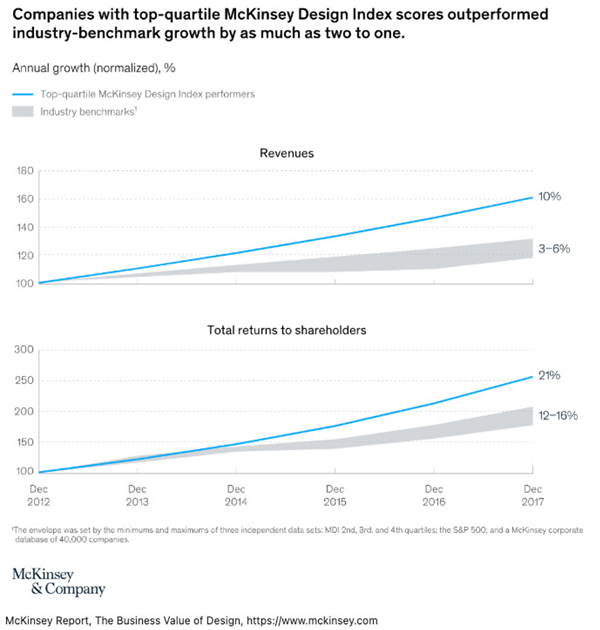
Please consider the following report from McKinsey Quarterly, which found companies that scored within the top-quartile McKinsey Design Index, outperformed industry-benchmark growth by as much as two to one.
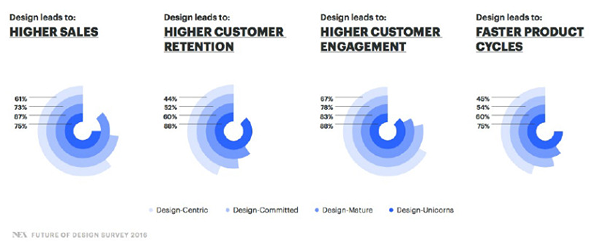
In addition, The Future of Design Survey, reports that greater emphasis on design maturity within organizations leads to higher sales, higher customer retention, customer engagement, and faster product cycles.
In addition we can expect,
- Accelerated Development Efficiency
- Developers can spend more time on improving a product, shipping updates, or building something brand new.
- Built-in consistency through a single source of truth with tried and tested components that can be applied to any project
- Speeds Up Design & Development Cycles by scaling design across an organization and ensuring product delivery
- Streamlines Design-to-production Workflows
- Less Redundancy
- Faster Prototyping
Designers who have access to a relevant design system can expect to deliver "34% more design work... equivalent to adding another 3.5 designers to the team each week!"
– Measuring the value of design systems | Figma Blog
Customer Impacts of Design Systems
Design systems can also positively impact KPIs that measure customer behavior and product adoption, which include,
- Conversion of trial users
- Win/loss rates
- ARR and Growth
- Customer retention and/or abandonment
- NPS Scores